
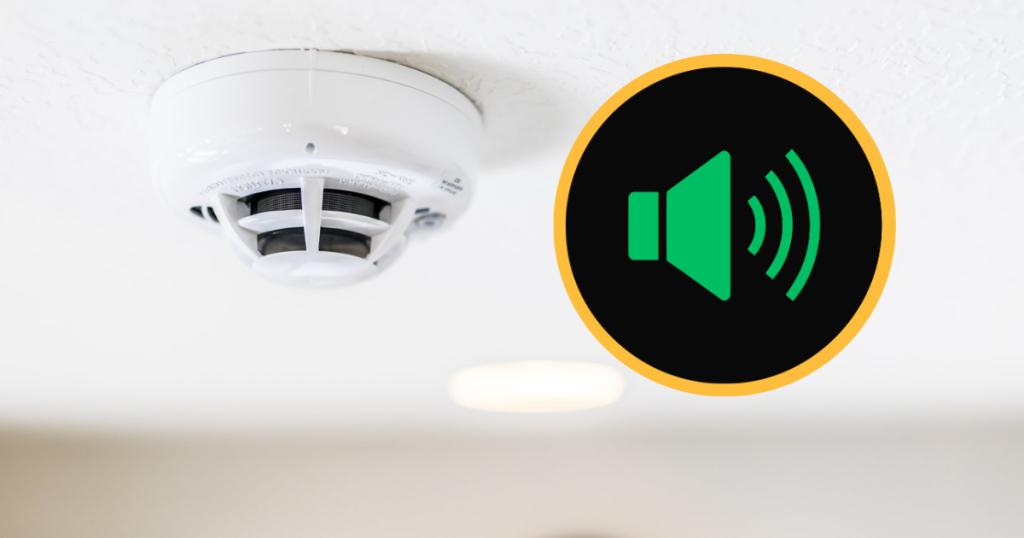



We know why you’re here – it’s probably 2:45 am and there’s a single, infuriating, single chirp coming from somewhere in the house every 30 seconds or so. You’ve checked the kitchen, you’ve checked the hallway, and you’re now standing on a chair squinting at a small white disc on the ceiling, whispering why is my smoke alarm beeping when nothing’s on fire?
Obviously, a smoke alarm’s whole job is to make noise, and we all know what that real alarm sounds like – that loud, urgent, impossible-to-ignore, neighbours-also-hear-it screech that means get out now!
But this isn’t that. This is something else entirely.
The different sounds your alarm actually makes
Well, it turns out that smoke alarms actually do make a few different sounds – each one meaning something different. And most of them have got nothing to do with actual smoke or fire.
1. The full alarm
Loud, continuous or fast-pulsing – and basically impossible to sleep through. This is the real deal: smoke’s been detected, or something’s triggering the sensor strongly enough to treat as fire.
Never ignore this one, even if you’re fairly sure it’s just overdone toast.
2. The low battery chirp
A single, short beep roughly every 30-60 seconds. This is a smoke alarm beeping rather than alarming in its most common form, and it’s almost always a battery running low. A quiet, beepy request from the smoke alarm for some fresh power before it gives up entirely.
3. The end-of-life signal
Confusingly, this often sounds a lot like the low battery chirp – in fact, it’s sometimes identical depending on the model. The difference is that a fresh battery won’t fix it, because the unit itself has reached the end of its service life – generally around 1 year – and the internal sensor is no longer considered reliable enough to trust.
Some models flash an LED in a slightly different pattern to help tell the two apart, so it’s worth checking your specific model’s manual or specs if you’re not sure.
4. The intermittent fault signal
A smoke alarm beeping intermittently, in a pattern that doesn’t quite match the steady low battery chirp, can point to a fault with the unit itself or, in interconnected systems, a communication issue between linked alarms.
5. Hardwired power interruption
A hardwired smoke alarm beeping after a power flicker or outage is often just registering the interruption, even briefly. It can keep going after power’s restored until it’s properly reset.
How to stop smoke alarm from beeping
Just want to stop smoke alarm beeping sounds before you go mad? We’ll start with the quickest fix and work our way down to the more involved ones.
Step 1: Identify which alarm it is
If you’ve got more than one in the house, this is the annoying part. Walk through room by room and listen closely, since the chirp is usually quiet enough that it can seem like it’s coming from a different room entirely.
Step 2: Replace the battery
If it’s a single chirp every 30-60 seconds and the unit takes a replaceable battery, start here. It solves the problem more often than not, and it’s the cheapest fix by far.
Step 3: Check if chirping continues after the swap
If your smoke alarm keeps beeping even with a brand new battery in it, that’s a useful clue. It usually rules out the battery entirely and points toward end-of-life or a fault instead.
Step 4: Check the manufacture date
Flip the unit off its mounting bracket if you can and look for a date printed on the back. If it’s around a decade old, or older, that’s likely your answer regardless of what the chirp pattern actually sounds like.
Step 5: Rule out dust, insects & humidity
A smoke alarm beeping for no reason you can identify is sometimes just a sensor confused by something.
Could be:
- Dust build-up
- A spider that’s moved in
- Steam from a nearby bathroom or kitchen.
A gentle clean with a vacuum attachment, or relocating the alarm slightly further from steam sources, can solve this without needing a replacement at all. Alarms mounted too close to a kitchen or ensuite are especially prone to this kind of nuisance triggering.
Step 6: Reset hardwired & interconnected systems
If it’s hardwired, switching it off at the circuit breaker for 30 seconds and then back on can clear a lingering fault from a power interruption. For interconnected systems, this sometimes needs doing at each unit, not just the chirping one.
Step 7: Replace the unit if nothing else works
If you’ve been through all of the above and you’re still asking why does my smoke alarm keep beeping, it’s time to stop troubleshooting and just replace it. Never disable or remove a working alarm as a way of dealing with the noise – a house without a working smoke alarm is a genuinely dangerous place to be, chirping or not.
What Fluid Electrical can do for you
If it’s a hardwired or interconnected system, or you’ve got an older alarm setup that’s never really been looked at properly, this is exactly the kind of job our licensed electricians handle regularly.
We can:
- Test your existing alarms
- Replace units that have reached end of life
- Upgrade to a fully interconnected system.
While we’re there, it’s also worth checking your setup actually meets current NSW requirements – which means photoelectric calarms, hardwired and interconnected where mains power’s available, and replaced within 10 years of manufacture. If your alarms pre-date that, a replacement is a good moment to bring the whole system up to standard rather than just swapping one unit for another.
So if your fire alarm beeps randomly at night and you’ve run out of things to try, get in touch with Fluid Electrical. We’ll sort out what’s causing it and make sure your home’s properly covered as well as nice and quiet!